The AI Dental Office: What Every Team Needs to Know in 2026What to Automate, What Never to Automate, and How Smart Practices Are Winning More Time, More Patients, and More Profit

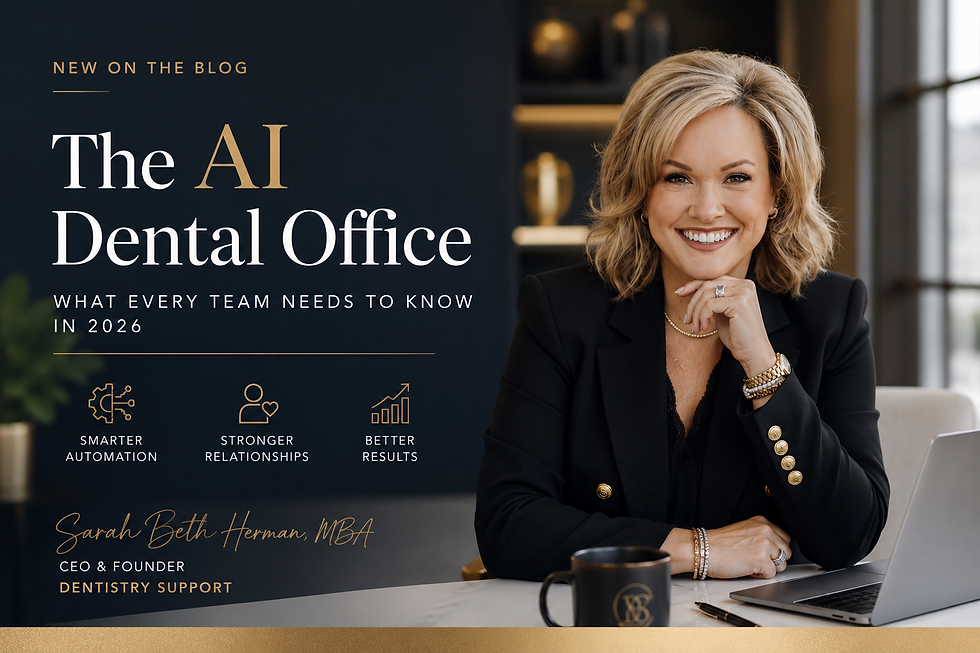
Sarah Beth Herman, MBA, CEO & Founder, Dentistry Support
Abstract
Artificial intelligence (AI) is rapidly transforming dental practice operations. From appointment scheduling and patient communication to recall systems and administrative workflows, AI-powered technologies are helping practices improve efficiency and reduce operational burdens. However, confusion remains regarding which functions should be automated and which require human involvement. Drawing from more than 25 years of experience in dentistry, this article examines practical applications of AI in dental practices, identifies areas where automation creates value, discusses the limitations of AI, and explores how practices can leverage technology while preserving the patient relationships that drive long-term success. The findings suggest that the most successful dental practices in 2026 will not replace people with technology. Instead, they will combine intelligent automation with experienced dental support professionals to improve patient experiences, strengthen operational performance, and support sustainable growth.
The AI Dental Office: What Every Team Needs to Know in 2026
After more than 25 years in dentistry, I have learned that successful practices rarely succeed because they have the newest technology. They succeed because they consistently create trust, build strong patient relationships, and develop systems that support both patients and team members.
Today, artificial intelligence has become one of the most discussed topics in dentistry. Practice owners are being introduced to AI receptionists, AI scheduling systems, AI-powered communication platforms, automated treatment follow-up systems, and AI-assisted documentation tools. Some view these innovations as the solution to staffing shortages and increasing administrative demands. Others are hesitant, concerned that technology may create a less personal patient experience.
In my experience, the truth lies somewhere in the middle.
Artificial intelligence can significantly improve efficiency and consistency within a dental practice. However, technology should never replace the human connection that serves as the foundation of patient trust. The practices experiencing the greatest success are not replacing people with technology. They are using technology to support people and allow their teams to focus on higher-value interactions that improve patient care and strengthen relationships.
Why AI Matters in Modern Dentistry
Dental practices face increasing pressure to improve efficiency while maintaining exceptional patient experiences. Patients expect rapid communication, convenient scheduling options, digital accessibility, and timely responses to questions. At the same time, dental teams are often managing staffing challenges, growing administrative responsibilities, and increasing operational costs.
These realities have created opportunities for AI-powered systems to support daily practice operations.
Research suggests that AI applications in healthcare can improve workflow efficiency, reduce repetitive administrative tasks, and support more consistent communication processes (Schwendicke et al., 2020). For dental practices, this means technology can help reduce administrative burdens while allowing team members to focus on patient-centered activities.
The goal is not automation for the sake of automation. The goal is creating a better experience for both patients and dental teams.
AUTOMATE THE TASKS. SAVE THE TIME.
One of the most important lessons dental leaders are learning about artificial intelligence is that automation works best when it supports systems, not relationships. For years, dental practices have struggled with many of the same operational challenges. Phones ring while team members are helping patients at the front desk. Appointment confirmations require constant follow-up. Recall systems become inconsistent during busy seasons. Administrative responsibilities continue to increase while staffing challenges remain a reality throughout healthcare.
These are not new problems.
What is new is the availability of technology capable of handling many of these repetitive responsibilities with remarkable consistency. The purpose of automation is not to remove people from the practice. The purpose is to remove repetitive tasks from people so they can focus on activities that require judgment, communication, and patient care.
Scheduling and Appointment Coordination
Scheduling remains one of the most time-consuming responsibilities within a dental office. Patients increasingly expect immediate access to scheduling options regardless of business hours.
AI-powered scheduling systems can assist practices by:
• Providing available appointment options
• Confirming appointments automatically
• Sending reminder notifications
• Managing cancellations
• Supporting waitlist management
• Responding to routine scheduling inquiries
When implemented effectively, scheduling automation creates convenience for patients while reducing interruptions for administrative teams. The result is often a smoother patient experience and improved operational efficiency. Patient communication workflows patients expect communication that is timely, consistent, and convenient.
Many practices struggle to maintain communication standards because administrative responsibilities consume significant portions of the workday.
AI-assisted communication systems can support:
• Appointment reminders
• Recall notices
• Treatment follow-up messages
• Post-operative instructions
• Educational communications
• Patient satisfaction requests
These systems help ensure patients receive important information without requiring constant manual oversight. Consistency is often the greatest benefit, patients are more likely to remain engaged when communication occurs reliably and predictably.
Recall and Reactivation Systems, missed recall opportunities represent one of the most common sources of lost production within dentistry. Patients become busy, life gets complicated, preventive care appointments are postponed. Without consistent follow-up, many patients unintentionally disappear from active care.
AI-supported recall systems help practices maintain contact through automated outreach and communication tracking.
These systems can identify overdue patients, trigger reminders, and support reactivation efforts that might otherwise be overlooked during busy periods. For practices focused on growth, recall consistency remains one of the most valuable applications of automation. Administrative Support and Documentation
Administrative work is essential, but it is rarely the highest-value use of a talented dental professional's time.
Modern AI tools can assist with:
• Documentation support
• Workflow organization
• Communication tracking
• Administrative task management
• Data organization
By reducing administrative burdens, practices create additional capacity for patient care, team development, and operational improvement. Ultimately, automation creates value when it saves time. The true question is not whether technology can perform a task. the question is whether automating that task allows your team to spend more time doing work that only people can do.
Why Human Relationships Remain the Foundation of Every Successful Practice
While artificial intelligence continues to transform dentistry, one truth remains unchanged:
Patients do not build relationships with software, Patients build relationships with people. Technology can improve convenience. Technology can improve speed, technology can improve consistency technology cannot replace trust.
Throughout my career, I have seen firsthand that trust remains one of the most valuable assets any practice can build. Patients return to offices where they feel respected, understood, and genuinely cared for. That reality has not changed. In many ways, it has become even more important the Emotional Side of Dentistry.
Dentistry is both a clinical profession and a relationship profession, many patients enter the dental office carrying concerns that extend far beyond oral health. Some patients experience anxiety, others have financial concerns. Many have had negative dental experiences in the past some simply need reassurance before moving forward with treatment. These situations require empathy, patience, and emotional intelligence. No technology platform can fully replicate these human qualities.
The Most Important Conversations Still Require People
There are certain moments within a patient journey where human interaction remains essential.
• Discussing treatment concerns
• Addressing dental anxiety
• Managing complaints
• Resolving misunderstandings
• Explaining financial options
• Supporting difficult decisions
These conversations require listening, understanding, and adaptability. Patients often need more than information. They need confidence, they need encouragement, they need someone who genuinely cares about their experience.
Why Empathy Creates Competitive Advantage
As technology becomes more common across healthcare, empathy becomes more valuable. Practices that consistently create positive emotional experiences often enjoy:
• Higher patient retention
• Increased referrals
• Greater treatment acceptance
• Stronger online reputation
• Higher patient satisfaction
Patients may forget specific details of a procedure they rarely forget how they were treated. The practices that continue prioritizing relationships will maintain a significant advantage regardless of technological advancements. technology should enhance relationships. It should never replace them. The goal is not less human interaction.
The goal is creating more time for meaningful human interaction.
Building the Dental Practice of the Future
The most successful practices in 2026 are not choosing between technology and people. They are leveraging both, they understand that technology and human expertise serve different but complementary purposes. Technology provides efficiency. People provide connection. Together, they create stronger organizations.
Empower Your Team
One of the most significant misconceptions surrounding artificial intelligence is the belief that automation reduces the value of employees. The opposite is often true. When repetitive tasks are reduced, team members gain opportunities to contribute in more meaningful ways.
Instead of spending excessive time on administrative activities, they can focus on:
• Patient experience
• Treatment coordination
• Case acceptance support
• Relationship development
• Professional growth
• Practice improvement initiatives
The best technology investments empower people rather than replace them. elevate the Patient Experience, every technology decision should ultimately improve the patient experience. Before implementing any system, practice leaders should ask:
Will this improve communication?
Will this reduce frustration?
Will this increase convenience?
Will this support our team?
Will this help us serve patients more effectively?
If the answer is yes, the investment may create meaningful value. Technology should simplify experiences rather than complicate them. Patients should notice improved service, not additional barriers.
Drive Growth Through Consistency
Sustainable growth rarely occurs because of a single innovation. Growth is usually the result of consistent systems operating effectively over time. AI can help practices improve consistency in areas such as scheduling, communication, recall, follow-up, administrative workflows, and operational organization. When these systems function reliably, practices are able to create a more predictable experience for both patients and team members. Consistency creates predictability. Predictability creates stability. Stability creates growth.
Build Lasting Practice Value
Strong practices are built on systems that continue producing results year after year. The combination of intelligent automation and experienced dental professionals creates an environment where practices can operate more efficiently while preserving the patient-centered culture that drives long-term success. The future of dentistry is not technology versus people. The future is technology supporting people. When automation handles repetitive tasks and talented professionals focus on patient care, practices become stronger, teams become more effective, and patients receive a better overall experience. That is the opportunity artificial intelligence presents to dentistry in 2026 and beyond.
Conclusion
After more than two decades in dentistry, I remain convinced that relationships will always be the foundation of successful dental practices. Technology will continue to evolve, and AI will undoubtedly play a larger role in practice operations. However, patients will continue to value trust, empathy, communication, and personalized care. The practices that thrive in 2026 and beyond will be those that use AI strategically. They will automate repetitive administrative tasks while preserving the human interactions that create meaningful patient experiences.
At Dentistry Support, we believe the future of dentistry is not technology versus people. The future is technology supporting people so they can serve patients more effectively, more consistently, and with greater confidence. When practices combine intelligent systems, experienced support professionals, and a commitment to patient-centered care, everyone benefits. Most importantly, patients receive the attention and service they deserve.
References
American Dental Association. (2024). Artificial intelligence in dentistry: Opportunities and considerations. American Dental Association.
Davenport, T., & Kalakota, R. (2019). The potential for artificial intelligence in healthcare. Future Healthcare Journal, 6(2), 94–98. https://doi.org/10.7861/futurehosp.6-2-94
Joda, T., Gallucci, G. O., Wismeijer, D., & Zitzmann, N. U. (2023). Augmented and artificial intelligence in dental medicine: A systematic review. Journal of Dental Research, 102(4), 387–398.
Mesko, B., Hetényi, G., & Győrffy, Z. (2018). Will artificial intelligence solve the human resource crisis in healthcare? BMC Health Services Research, 18(1), 545. https://doi.org/10.1186/s12913-018-3359-4
Schwendicke, F., Samek, W., & Krois, J. (2020). Artificial intelligence in dentistry: Chances and challenges. Journal of Dental Research, 99(7), 769–774.
Siau, K., & Wang, W. (2020). Artificial intelligence (AI) ethics: Ethics of AI and ethical AI. Journal of Database Management, 31(2), 74–87. https://doi.org/10.4018/JDM.2020040105
Topol, E. (2019). Deep medicine: How artificial intelligence can make healthcare human again. Basic Books.
Verghese, A., Shah, N. H., & Harrington, R. A. (2018). What this computer needs is a physician: Humanism and artificial intelligence. JAMA, 319(1), 19–20. https://doi.org/10.1001/jama.2017.19198
World Health Organization. (2021). Ethics and governance of artificial intelligence for health. World Health Organization.
World Economic Forum. (2023). Healthcare in the age of artificial intelligence: Opportunities and challenges. World Economic Forum.

Disclaimer:
To learn more about Sarah Beth Herman, the author of all free training content you can read her bio here. These materials are intended to provide helpful information to dentists and dental team members. They are in no way a substitute for actual professional advice based on your unique facts and circumstances. This content is not intended or offered, nor should it be taken, as legal or other professional advice. You should always consult with your own professional advisors (e.g. attorney, accountant, or insurance carrier). To the extent, Dentistry Support ®has included links to any third-party website (s), Dentistry Support ® intends no endorsement of their content and implies no affiliation with the organizations that provide their content. Further, Dentistry Support ® makes no representations or warranties about the information provided on those sites. You can view our privacy policy and terms and conditions by clicking those pages in the footer of our website


Comments